Blog

Stefan Zweig

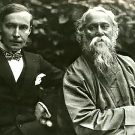
Stefan Zweig and Rabindranath Tagore

Stefan Zweig (1881-1941), the Austrian writer, and Thomas Mann were introduced to Rabindranath Tagore in the summer of 1921. True to their temperament, their reactions to Tagore were quite opposite to each other. Zweig, the suave cosmopolitan and altruistic humanitarian, had visited India in the winter of 1908/09.  Read more
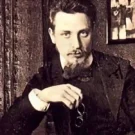
Rainer Maria Rilke

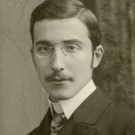
Rainer Maria Rilke and Rabindranath Tagore

Even a few months before Tagore was awarded the Nobel Prize, Rainer Maria Rilke (1875-1926) recognized Tagore’s importance which he expressed in a letter to Lou Andreas-Salomé[1]. Rilke had heard another famous writer, the Frenchman André Gide, read out his French translation of Gitanjali which had impressed Rilke considerably. Read more

Rabindranath Tagore (right) with his German publisher Kurt Wolff (left) in 1921. Image credit: Martin Kaempchen/ Visva-Bharati University

Rabindranath Tagore his German publisher Kurt Wolff

“Being a publisher is not a profession, it’s a passion, an obsession.” This line from a letter written by Kurt Wolff could well have been the motto of his entire life. He was one of the most extraordinary personalities of German publishing in the 20th century. Wolff’s career spanned fifty years of publishing experience and brought together in his person the classical ethos of the 19th century as well as the dynamic, feverish search for new areas of experience characteristic of the 20th century. Read more

Hermann Keyserling

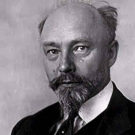
Rabindranath Tagore and Hermann Keyserling: A Difficult Friendship

Rabindranath Tagore, the Indian poet, and Count Hermann Keyserling, the German philosopher, met on three different occasions: in Calcutta (1912), in London (1913) and again in Darmstadt/Germany (1921). During Tagore’s highly publicized trip through Germany in May/June 1921, Keyserling projected himself as Tagore’s friend and guide. Read more

Albert Einstein and Rabindranath Tagore

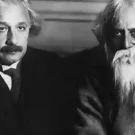
Albert Einstein and Rabindranath Tagore

Rabindranath Tagore and the famous German theoretical physicist Albert Einstein (1879-1955), who developed the general theory of relativity and won the Nobel Prize in Physics (1921), met several times. Two of their conversations – which tackled questions of free will, the universality of truth and beauty, and a comparison between Eastern and Western music – have been recorded, published and celebrated by the media. Read more